
Solo diving is a completely different diving philosophy that requires very good training, extensive experience and appropriate preparation. Underwater there is no partner you can rely on for help, so you take full responsibility for yourself, your equipment and the course of the dive on your own shoulders.
SOLO DIVING – RESPONSIBILITY FOR YOURSELF ALONE
Solo diving is a completely different diving philosophy. It requires significantly more preparation, experience and self-reliance, because underwater we cannot count on a partner – we must be prepared for every situation ourselves.
TRAINING IS THE MOST IMPORTANT
To start a solo diving course, you must first go through a long training path. In the case of Independent Diving in SSI meeting minimum requirements means completing approximately six other courses.
Courses alone are not everything, though. You also need experience and very good mastery of your own equipment and diving skills.
Solo diving should not be treated as just another step simply because someone already has the appropriate number of dives. It is a completely different way of thinking about safety underwater.
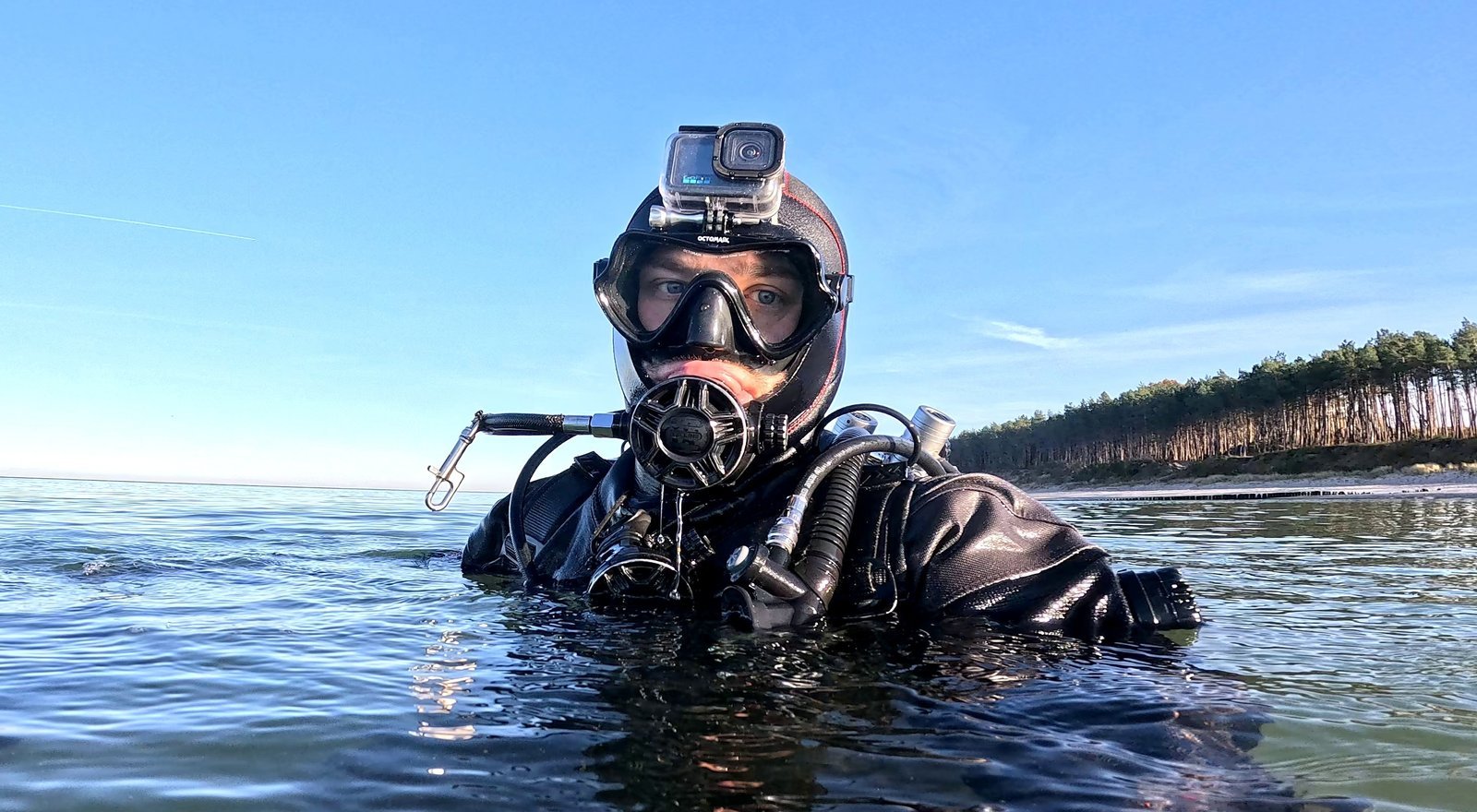
Solo diving should be reserved for experienced divers with hundreds of hours logged underwater. This is no longer just fun.
THE HARDEST COURSE IN MY CAREER
The solo diving course was the most difficult course I have ever taken in my entire diving career.
I prepared for it extensively and spent many hours underwater practicing specific situations that can occur during solo diving.
I spent particularly a lot of time on practicing emergency situations without a mask. These are exactly the kinds of training that show how important automatic execution of basic procedures and staying calm are when something starts to go wrong.
This course really tested me, but that's precisely why I consider it a must have for anyone who wants to dive alone consciously.
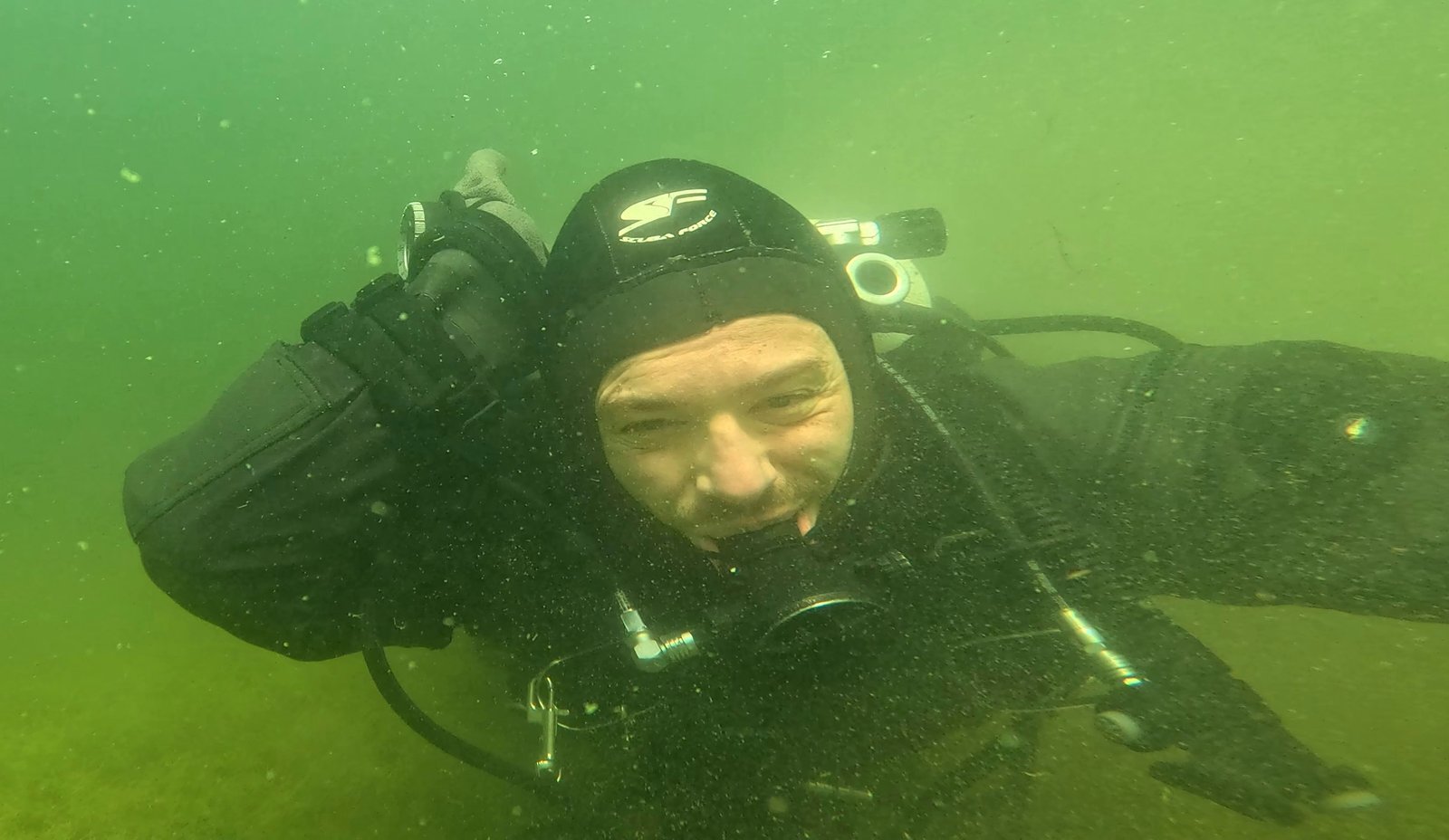
Turning tank valves without a mask. Simply opening your eyes underwater is not pleasant. Especially when the water is cold.
SOLO DIVING IS A NEW PHILOSOPHY
Diving without a partner changes the way you must think about diving as a whole.
It begins at the stage of planning and logistical backup, and ends with how we manage underwater.
There is no second person who can take over part of the tasks, help in an emergency or point out a problem that we ourselves have not noticed.
That is why everything must be thought through beforehand.
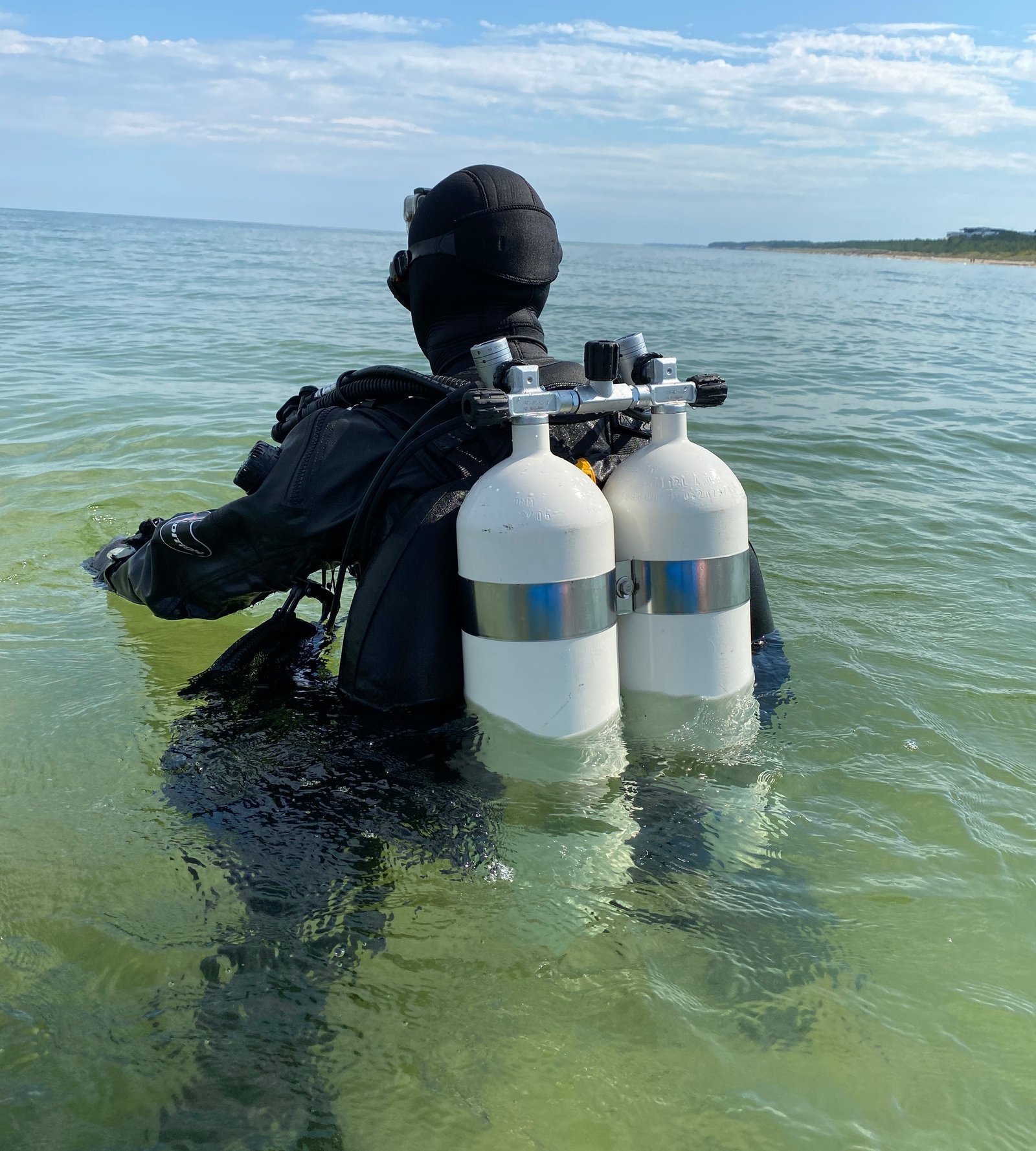
If I plan to dive deeper than 10 metres, I take a twinset – a double cylinder configuration – or an additional cylinder attached to the side, known as a stage.
EQUIPMENT MUST BE REDUNDANT
The basic principle of solo diving for me is no compromise when it comes to equipment.
Underwater, I rely only on myself, so I must be prepared for any failure and know how to handle it independently.
That's why all the most critical equipment must be redundant.
I have a cylinder with a dual outlet valve, two first stage regulators and two second stage regulators. In addition to this, I have two sources of buoyancy – a wing and a dry suit – and two masks. Not to mention the smaller items like, for instance cutting tools.
Also essential is a pressure gauge and a dive computer with a transmitter. The transmitter serves as a backup to the pressure gauge. It also increases safety because you additionally monitor your gas supply every time you look at the screen. There has to be a transmitter, and that's final.
In solo diving, I don't go by the rule "it'll be fine". Money is not a factor here – if equipment increases my safety, it has to be appropriate and in good working order. There's no discussion that something is only there as a backup and costs a lot. Nobody said it would be cheap.
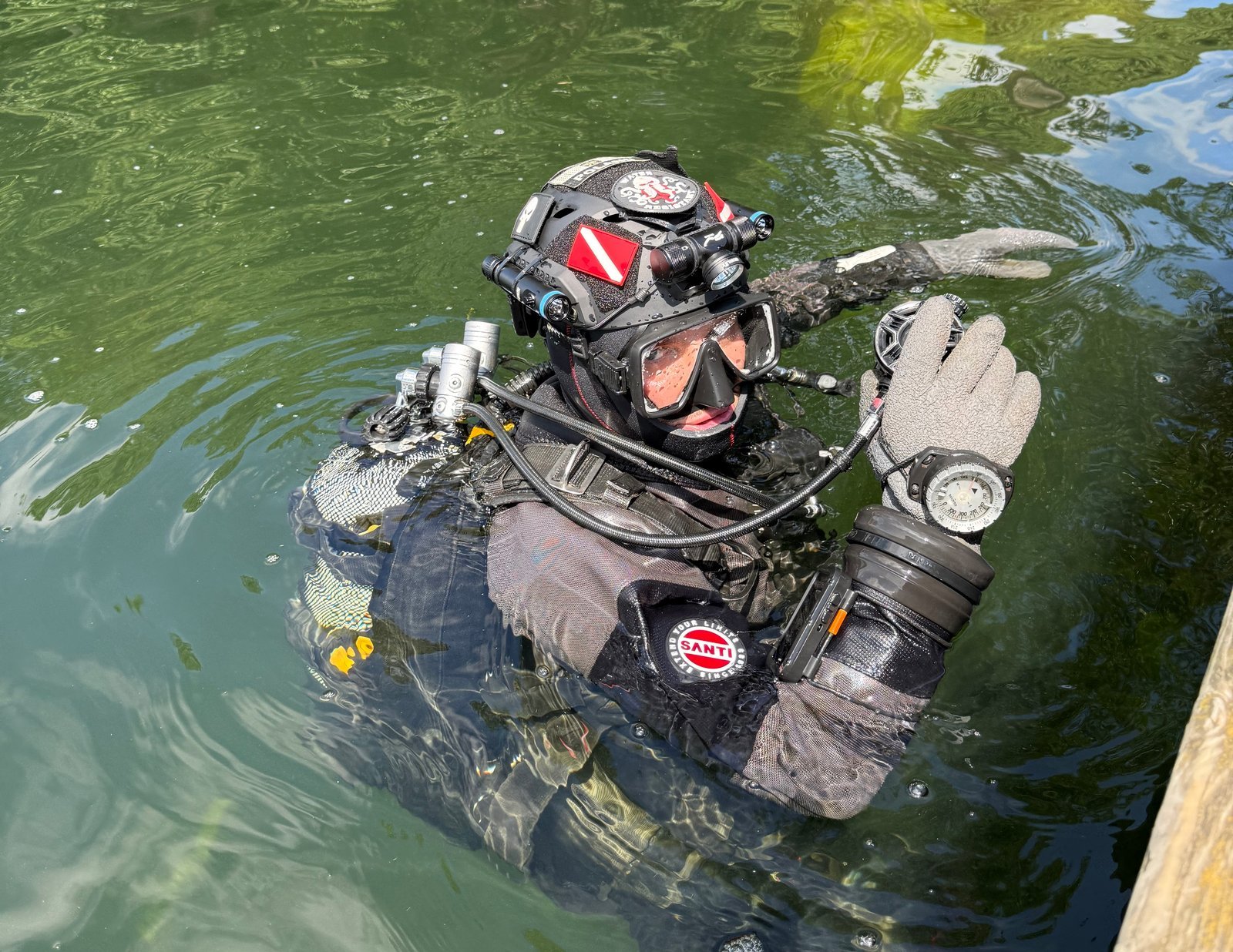
Even though the depths can be shallow, solo diving is no longer just recreational diving. Doing it without training, equipment, experience and certification is sheer stupidity.
DPV SCOOTER
An important part of my equipment is also a DPV scooter.
It allows for more efficient movement underwater and can be an additional element that increases safety during diving. It shortens the return time to shore in case of problems, the diver doesn't tire as much, which conserves air. It helps maintain safety in strong currents. Leaving shore and going far out into the Baltic without a scooter is idiocy.
Of course, using it also requires proper training and experience. Equipment alone won't substitute for skills.
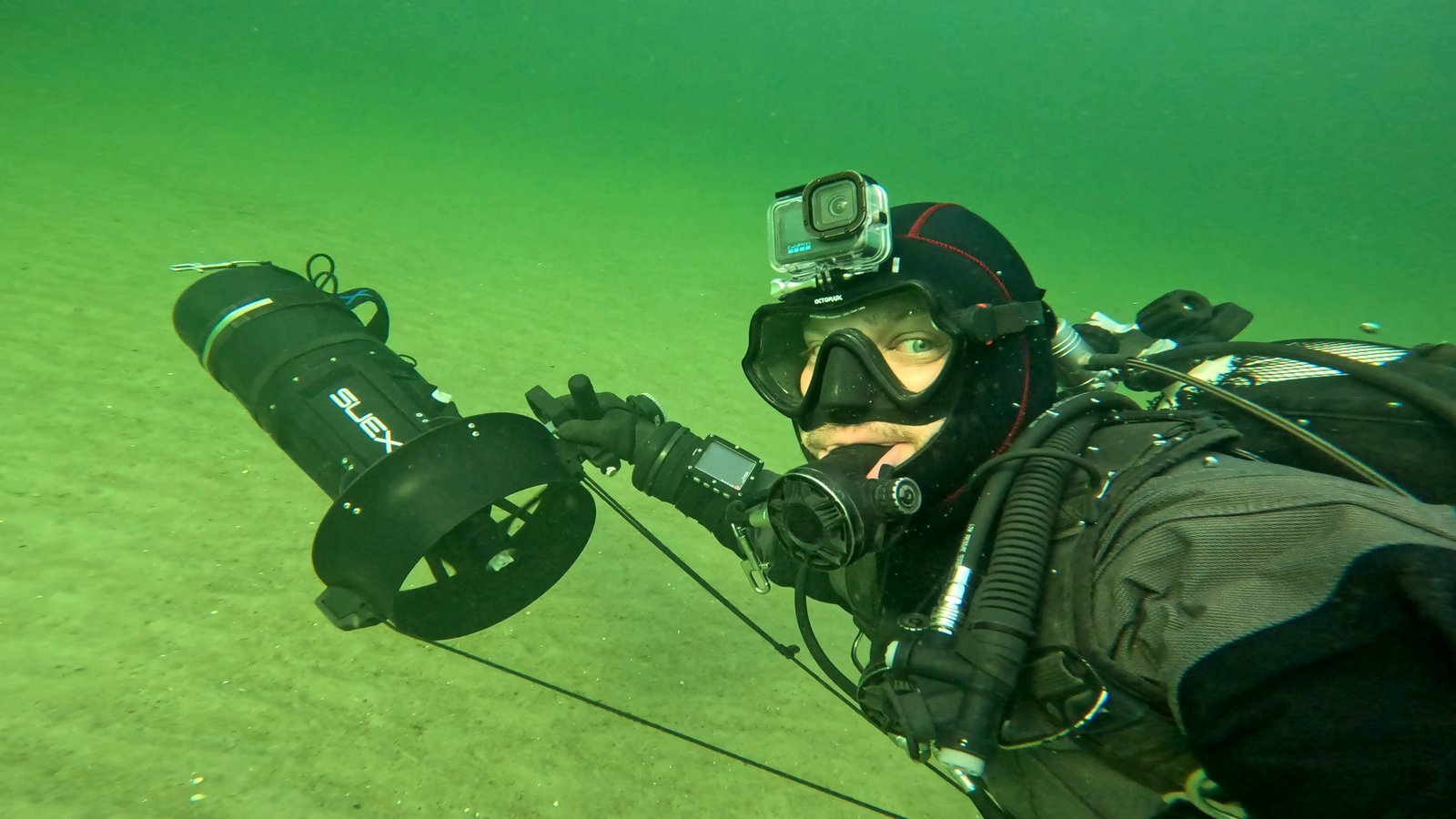
A scooter in the context of solo diving safety is a powerful tool. As soon as something goes wrong, we can quickly 'escape' back towards shore.
I DIVE SOLO ONLY SHALLOW
Despite all my preparation during solo dives I stay at shallow depths.
Usually I dive shallow and rarely exceed 10 metres depth.
This is a conscious decision based on my diving style and the type of activities I perform underwater.
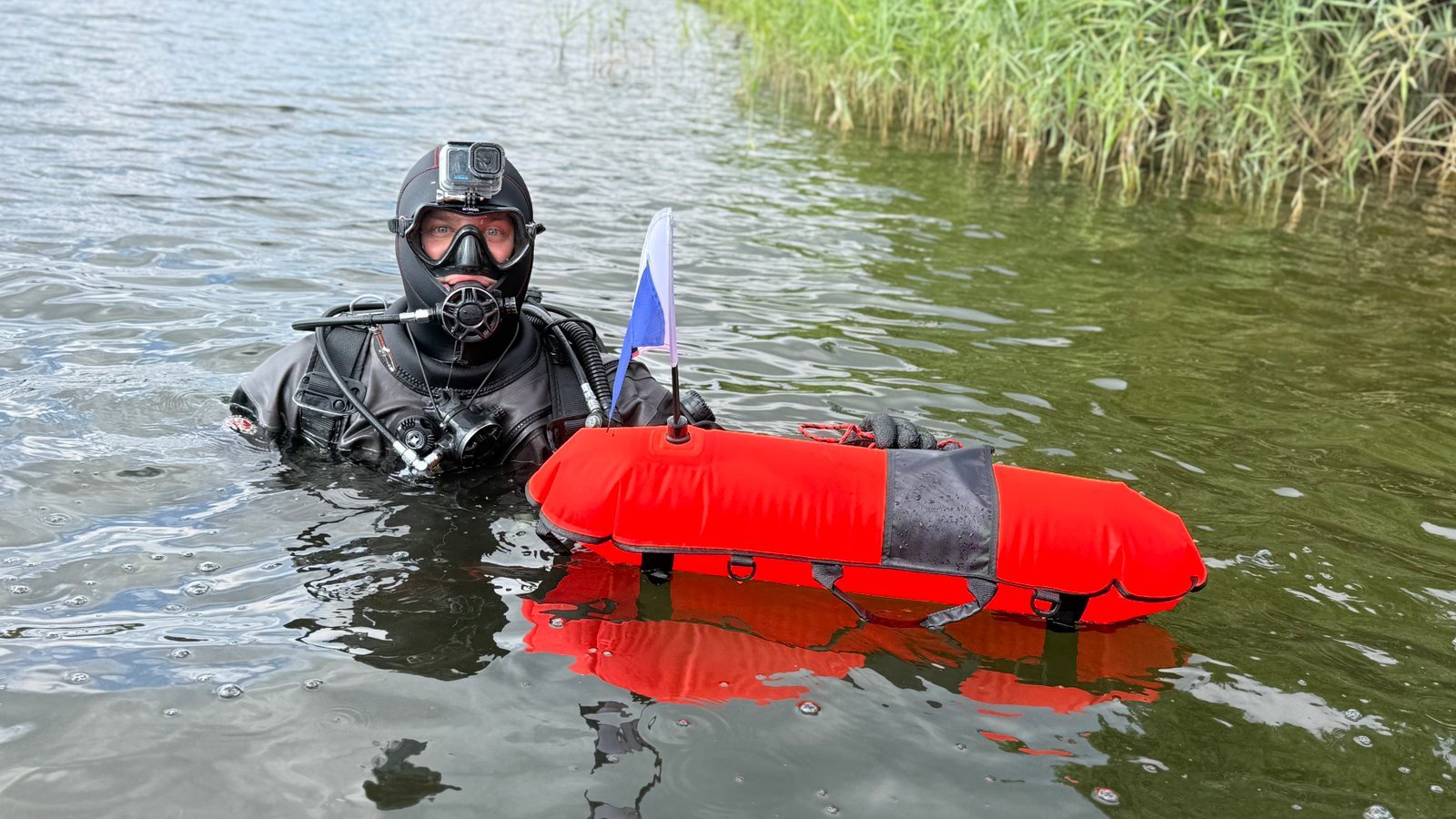
With increased depth, danger is not the only thing that rises. Air consumption also increases, which means shorter dives. For me, a standard dive lasts a minimum of 2 hours; if it's shorter than that, it's unsatisfying.
WHY DO I DIVE ALONE?
In my case, solo diving is primarily related to the specifics of my activities.
Finding a partner who would have a similar level of training, appropriate equipment, sufficient experience, and at the same time the time and desire to perform exactly the kind of dives I do, is close to miraculous.
A partner with a lower level of training or less suitable equipment will not be able to perform such dives. In practice, this would also mean limiting my activities.
That is why in my case solo diving is a conscious choice resulting from what and how I do underwater.
COMPLETE INDEPENDENCE
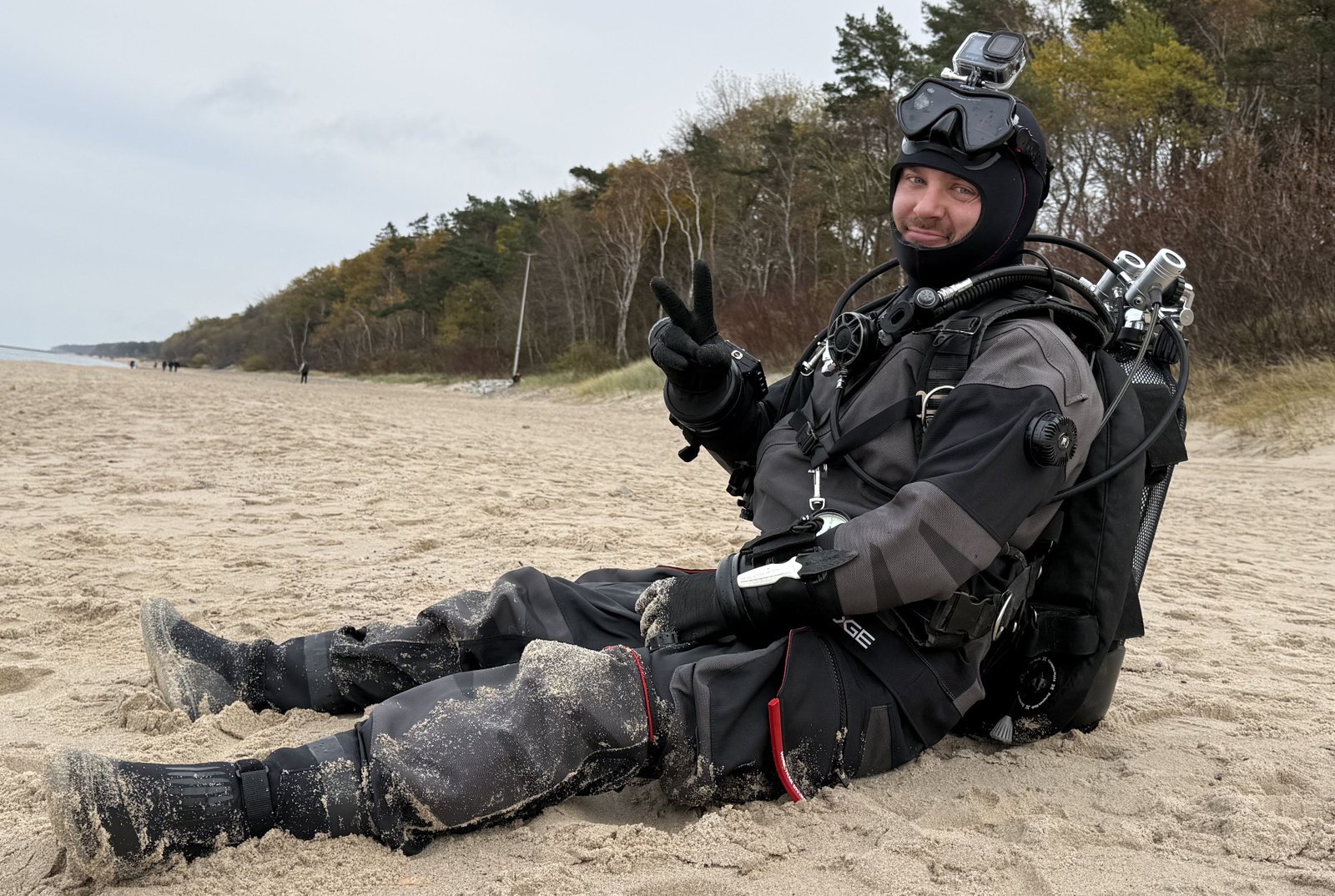
Diving alone also gives something that buddy diving does not give – complete independence.
I do what I want and when I want. I do not need to take into account the decisions, opinions or possibilities of another diver.
I plan the dive myself and I am responsible for its execution.
I am only responsible for myself. This gives incredible freedom underwater.
DOES ANOTHER DIVER ALWAYS MEAN GREATER SAFETY?
It is often said that diving with a partner increases safety. However, this is not a black-and-white issue for me.
It may increase safety, but it does not have to.
Another diver is also another potential source of equipment failure and human error. Every additional problem can result in ending the dive.
With two people, there is also the possibility that the problem will concern the partner, and then I will need to respond to their situation.
This does not mean, of course, that diving with a partner is dangerous. The point is that the mere presence of another diver does not guarantee safety. Diving alone, I am much more focused, alert, I do not relax, I know that no one will come to help me, so I operate with a much greater margin of error.
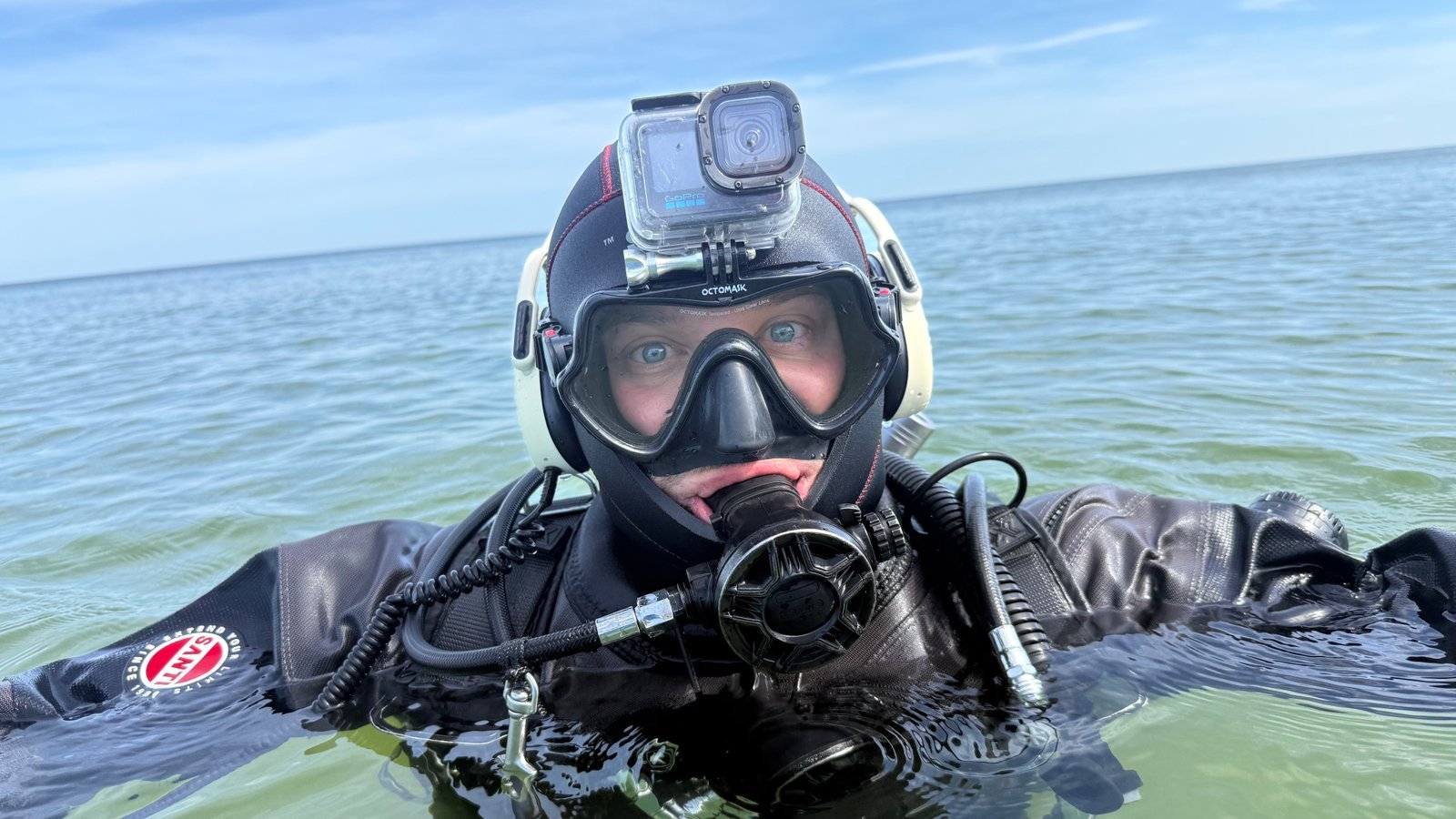
""If you can count, count on yourself" – a famous saying, but how well it captures the specifics of solo diving.
RESPONSIBILITY FOR EVERY DETAIL
Solo diving forces me to take a very careful approach to preparation.
I know that my training, experience, attention to detail and the use of high-class equipment that is regularly serviced have a direct impact on my safety.
I cannot assume that if a problem arises, someone will be nearby and solve it for me.
Therefore, before every dive I must be certain that I am able to handle an emergency situation myself.
I HAVE MY RULES
I have a very careful and consistent approach to diving.
I do not dive with people I do not know. I know what my requirements are regarding training, experience and equipment.
In solo diving, this consistency is even more important, because underwater there is no room for relying on chance.
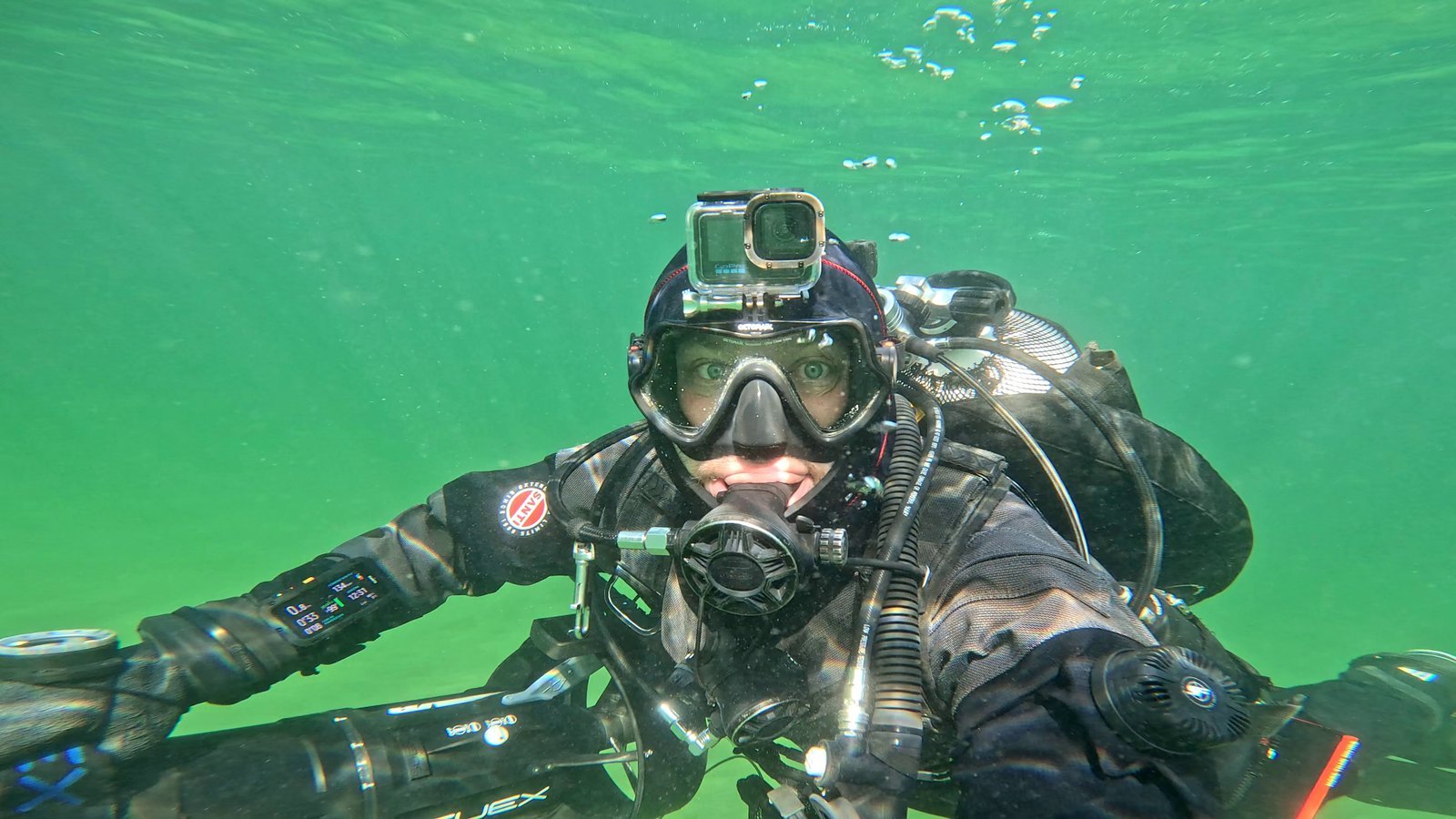
I have a very strict and rigorous approach to solo diving. I am uncompromising in this regard.
SOLO DIVING IS NOT FOR EVERYONE
Solo diving is not simply diving without a partner.
It is responsibility for the entire dive – from preparation and planning, through equipment, to emergency situations underwater.
That's why training and experience remain paramount. Only when these are at the appropriate level can one consciously decide whether solo diving is the right form of diving for us.
In my case, it is a deliberate choice resulting from the specifics of what I do underwater. And that is precisely why I treat solo diving very seriously.
Support me on Suppi!
Support on Suppi →